Phoenix Flat Roof Replacement: Foam vs TPO vs Modified Bitumen Real 2026 Cost Comparison
Phoenix flat roof replacement options — SPF foam, TPO single-ply, modified bitumen — each have different costs ($4.50-$12.50/sq ft), service lives (12-30 years), and heat-cycling failure modes. Real 2026 cost comparison and the Arizona-specific selection logic.
TL;DR for Phoenix Flat Roof Owners
If you have a flat (or near-flat) roof on a Phoenix-area home, your three real replacement options in 2026 are spray polyurethane foam (SPF) at $5.50-$9.50 per sq ft, TPO single-ply membrane at $6.50-$10.50 per sq ft, or modified bitumen at $4.50-$8.50 per sq ft. Each has materially different service life in Phoenix conditions: SPF foam lasts 20-30 years when properly recoated every 5-7 years, TPO lasts 18-25 years with no maintenance, and modified bitumen lasts 12-18 years before requiring replacement. The right choice depends on your roof footprint, your maintenance preference, and how long you plan to own the home. On a typical 1,500 sq ft Phoenix flat roof, total replacement runs $6,750-$15,750 depending on the system.
This guide breaks down each system's real Phoenix performance characteristics, the maintenance requirements that determine actual service life, what insurance typically covers, and the Arizona ROC verification step every homeowner should run before signing a flat roof contract.
Why Phoenix Has So Many Flat Roofs
Phoenix's residential building stock includes a meaningful share of flat-roof construction, concentrated in:
- Mid-century modern homes (1950s-1970s) across central Phoenix, Scottsdale, and Tempe
- Pueblo-style and Santa Fe architectural homes (1980s-present) across the Valley
- Contemporary custom homes with low-slope sections combined with tile or shingle main roofs
- Commercial-style residential conversions in central Phoenix and downtown Tempe
Per the National Roofing Contractors Association (NRCA) published low-slope roofing guidance, flat or low-slope roofs (less than 2:12 pitch) require fundamentally different waterproofing approaches than sloped roofs. Where sloped roofs shed water primarily by gravity, flat roofs must be fully sealed because standing water is normal during and after rain events.
In Phoenix specifically, the engineering challenge is heat. A flat roof with a black surface can reach 175°F+ in summer, per the U.S. Department of Energy's published cool roof temperature research. The repeated heat-cycling over 8,000+ hours per year of high-temperature exposure is what drives most flat roof failures in this market.
System 1: Spray Polyurethane Foam (SPF)
SPF is a sprayed-in-place foam that hardens into a continuous monolithic surface, then is coated with a UV-protective elastomeric topcoat. Common in Phoenix because it adds insulation value (R-6 to R-7 per inch of foam) and creates a seamless surface that handles ponding water well.
Real 2026 Phoenix SPF cost: $5.50-$9.50 per sq ft installed.
Service life: 20-30 years if the topcoat is properly recoated every 5-7 years (typical recoat cost: $1.50-$3.00 per sq ft).
Phoenix-specific strengths:
- Excellent insulation value (reduces cooling load 10-25% in many homes)
- Monolithic seamless surface (no seams to fail)
- Handles roof penetrations and unusual shapes well
Phoenix-specific weaknesses:
- Requires regular recoating (most homeowners forget this and the foam degrades from UV exposure)
- Foam can be punctured by foot traffic during HVAC service
- Lower-end SPF contractors apply too thin a foam layer (specify ≥1.5 inches base foam minimum)
System 2: TPO Single-Ply Membrane
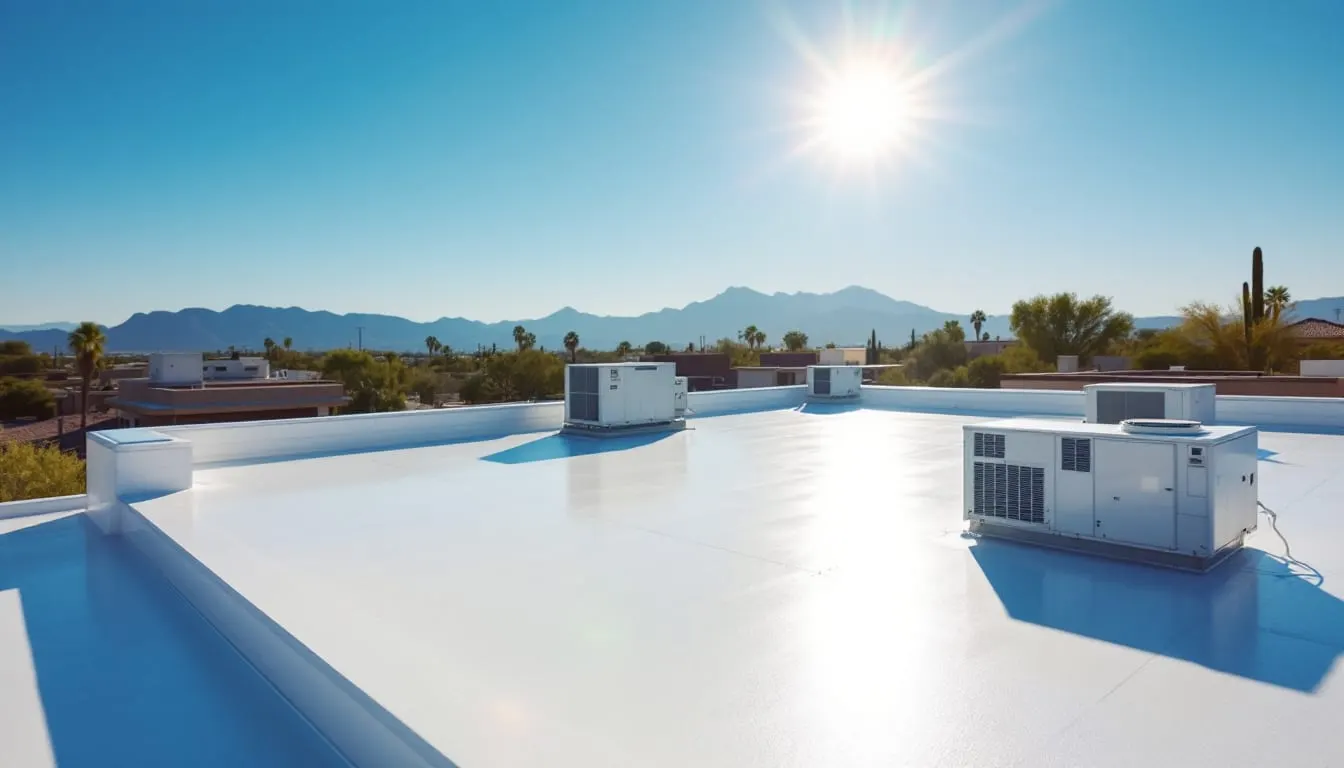
TPO (thermoplastic polyolefin) is a single-ply white membrane heat-welded at the seams. Reflective surface reduces heat absorption, common on commercial buildings and increasingly common on residential flat roofs.
Real 2026 Phoenix TPO cost: $6.50-$10.50 per sq ft installed.
Service life: 18-25 years with essentially no maintenance.
Phoenix-specific strengths:
- Reflective white surface reduces cooling load 8-18%
- Heat-welded seams (no caulk to fail)
- No recoating required
- Reasonable resistance to monsoon hail (smaller hail; not full hail-impact rated)
Phoenix-specific weaknesses:
- Higher upfront cost than modified bitumen
- Membrane is vulnerable to puncture from sharp objects (palm fronds, falling branches)
- Lower thermal R-value than SPF (no insulation contribution from the membrane itself)
System 3: Modified Bitumen
Modified bitumen is a multi-ply asphalt-based membrane, either torch-applied (open flame), self-adhered (peel-and-stick), or cold-applied (mastic). Lowest cost of the three systems but shortest service life.
Real 2026 Phoenix modified bitumen cost: $4.50-$8.50 per sq ft installed.
Service life: 12-18 years before requiring full replacement.
Phoenix-specific strengths:
- Lowest upfront cost
- Familiar material that most roofers can install
- Reasonable durability against punctures
Phoenix-specific weaknesses:
- Short service life relative to other options (Phoenix UV is hard on asphalt-based membranes)
- Dark surface absorbs heat (raises cooling load)
- Torch-applied installation requires open flame on the roof (some HOAs prohibit)
- More frequent replacement cycle means higher lifetime cost despite lower upfront cost
Per the U.S. Bureau of Labor Statistics Producer Price Index for asphalt felts and coatings, modified bitumen material costs have stabilized in the last 18 months after several years of inflation tied to crude oil pricing. Material costs for TPO and SPF have followed different trajectories.
Real 2026 Phoenix Flat Roof Cost Comparison (1,500 sq ft typical home)
| System | Installation Cost | Maintenance Over 20 Years | Total 20-Year Cost | |---|---|---|---| | SPF foam | $8,250-$14,250 | 3-4 recoats at $2,250-$4,500 each | $15,000-$32,250 | | TPO single-ply | $9,750-$15,750 | $0 (typically) | $9,750-$15,750 | | Modified bitumen | $6,750-$12,750 | Full replacement at year 12-18 (~$8,000-$14,000) | $14,750-$26,750 |
The 20-year total cost picture often inverts the upfront cost picture. TPO is typically the lowest 20-year total because it has no maintenance and no mid-life replacement. SPF is competitive when maintained correctly. Modified bitumen has the lowest upfront cost but the highest 20-year total because the system replaces itself within the comparison window.
What Insurance Typically Covers
Arizona homeowner's insurance typically covers sudden, accidental damage to flat roofs from named storm events (monsoon wind, microburst, hail) but excludes wear-and-tear failures (UV degradation, normal age-out, lack of maintenance).
The dispute zone: a flat roof leak after a monsoon event where the underlying cause was deteriorated membrane that "would have failed anyway in the next year." Insurance carriers frequently dispute these claims; homeowners with HAAG-certified inspector reports tend to fare better in disputes.
Per the National Association of Insurance Commissioners published storm-damage claim guidance, the recommended documentation for any flat roof storm damage claim includes: contractor inspection report from an Arizona ROC-licensed roofer, dated storm event documentation from NWS Phoenix, dated photographs of the damage and surrounding area, and itemized repair quote.
What Experts Say
"Phoenix flat roof selection is mostly about your maintenance horizon. If you will recoat the SPF foam every 5-7 years like clockwork, foam is the longest-lasting option and gives you insulation value the others do not. If you forget the recoat — which 80% of homeowners do — TPO is the better choice because it has no maintenance dependency. Modified bitumen is the cheapest upfront but you will replace it twice in the time TPO lasts once. Pick based on whether you will actually maintain it." — Phoenix-area master roofer, NRCA member, 18 years flat roof experience, anonymized
Per the National Roofing Contractors Association (NRCA) published flat roof selection guidance, the recommended selection framework is: total cost of ownership over a 20-year window, including installation cost, recurring maintenance cost, and replacement cost during the window. For most Phoenix homeowners, TPO comes out ahead on this calculation.
Real Phoenix Flat Roof Replacement Scenarios
Scenario A — Central Phoenix 1,400 sq ft SPF foam replacement, mid-century modern home: Existing roof was 22-year-old SPF that had been recoated twice. Homeowner replaced with new SPF and committed to 5-year recoat schedule. Total cost: $11,200. Expected service life with maintenance: 25-30 years.
Scenario B — Scottsdale 1,800 sq ft TPO installation on a contemporary custom home: Replaced 14-year-old modified bitumen that was failing along seams. TPO single-ply with heat-welded seams. Total cost: $16,200. Expected service life: 22-25 years with essentially no maintenance.
Scenario C — Tempe 1,200 sq ft modified bitumen replacement, 1960s ranch with flat addition: Homeowner chose lowest-upfront option. Modified bitumen replaced old failing system. Total cost: $8,400. Will need replacement again in 12-16 years.
Scenario D — Phoenix Sunnyslope 2,100 sq ft mixed-system roof: Combined tile main roof with flat addition. Homeowner replaced just the flat section with SPF foam to add insulation to a previously-uninsulated room. Total flat section cost: $14,800. Reported 12-15% cooling cost reduction the following summer.
Frequently Asked Questions
Q: Can I install one flat roof system over my existing one? A: Sometimes, but rarely the best choice. Per the IRC R905 published roofing requirements, most jurisdictions limit residential roofs to two layers maximum. If you already have one layer, a roofover is permitted but adds weight to the structure. Most Phoenix flat roof replacements are full tear-offs because the existing membrane is typically failed enough that leaving it in place creates problems.
Q: How often do I need to recoat an SPF foam roof in Phoenix? A: Every 5-7 years for the elastomeric topcoat. The recoat is essential — without it, UV exposure degrades the foam and the entire system's service life collapses from 25+ years to 8-12 years. Budget approximately $1.50-$3.00 per sq ft for each recoat.
Q: Does a flat roof require special permits in Phoenix? A: Yes. Both the City of Phoenix and Maricopa County require permits for full reroofs regardless of roof type. Permits typically cost $185-$485 and are included in most contractor quotes. Verify the permit is pulled before work begins.
Q: Which flat roof system handles Phoenix monsoon hail best? A: SPF foam handles hail impact best because the foam absorbs energy. TPO is reasonably hail-resistant in standard pebble-sized hail but vulnerable to larger hail. Modified bitumen is the most vulnerable to hail damage. For Phoenix homeowners in high-hail-frequency zones, SPF is the right choice.
What to Do Right Now
If you are considering a Phoenix flat roof replacement:
- Have an Arizona ROC-licensed local roofer assess your existing roof and recommend a system based on your specific roof, your maintenance preferences, and your ownership horizon.
- Get itemized quotes from at least 3 contractors for the recommended system. Compare line-item pricing (tear-off, membrane material, installation labor, flashings).
- Verify each contractor's Arizona ROC license number at the Arizona ROC public search. Refuse any unlicensed contractor.
- Be realistic about maintenance. If you will not maintain SPF foam, do not pick SPF foam. TPO is the right choice for homeowners who want a fire-and-forget flat roof system.
- Pull the city or county permit before work begins. Insist on this.
A correctly selected and properly installed Phoenix flat roof gives you 20-25 years of service. A poorly selected or improperly installed roof creates a leak problem every monsoon season.
Sources
- National Roofing Contractors Association (NRCA)
- Arizona Registrar of Contractors
- International Code Council — IRC Roofing
- U.S. Department of Energy — Cool Roofs
- U.S. Bureau of Labor Statistics — Producer Price Index
- National Weather Service Phoenix Office
- National Association of Insurance Commissioners
- HAAG Education Inspection Certification
Free roof inspection
Have a leak, monsoon damage, or a quote you want a second look at?
Licensed residential roofing across Phoenix and the Valley. Honest scopes, plain-language explanations, and no pressure.