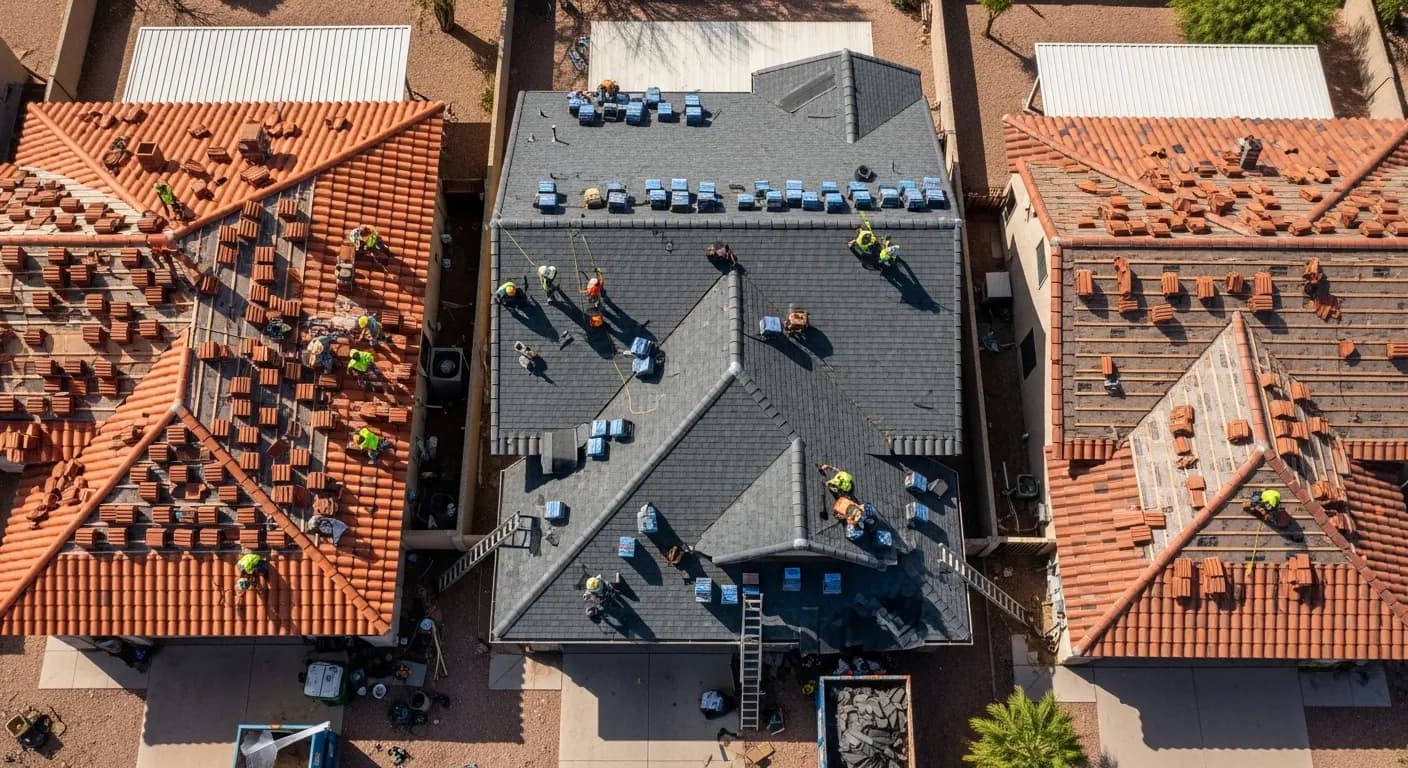
Phoenix Roof Replacement Cost 2026: Tile vs Shingle vs Tile-Over by Sq Ft + Permit Reality
Real 2026 Phoenix roof replacement cost ranges by sq ft for tile, asphalt shingle, and tile-over installs — plus Maricopa permit reality, IRC R905 code requirements, and Arizona ROC contractor verification.
TL;DR for Phoenix Homeowners
If you are pricing a Phoenix roof replacement in 2026, expect to spend roughly $4.50–$7.00 per square foot for a tear-off-and-reroof in asphalt shingle, $8.50–$14.00 per sq ft for a full concrete tile system, and $5.50–$8.50 per sq ft for a tile-over (tile reused, underlayment replaced) install. On a typical 2,400 sq ft Phoenix tract home with roughly 2,800 sq ft of actual roof surface, that translates to $12,600–$19,600 for shingle, $23,800–$39,200 for tile, and $15,400–$23,800 for tile-over. Maricopa County and the City of Phoenix both require permits on full reroofs and on structural deck work — going un-permitted is the single most common way Phoenix homeowners destroy resale value and void insurance coverage. Verify any contractor's Arizona Registrar of Contractors (ROC) license before signing anything.
Why 2026 Phoenix Reroof Pricing Looks Different Than 2022
Three things have moved Phoenix roof replacement pricing materially in the last 18 months: asphalt-binder cost inflation, concrete-tile freight costs, and a labor market that is finally rebalancing after the post-pandemic surge.
The U.S. Bureau of Labor Statistics Producer Price Index for "asphalt felts and coatings" climbed steadily through 2023–2025 and has only flattened in the last two quarters (source: BLS PPI series, construction materials). That feeds directly into shingle, underlayment, and modified-bitumen pricing on every Phoenix reroof.
Meanwhile, the U.S. Census Bureau's residential remodeling and repair construction spending data shows nationwide residential roof spending still running 18-22% above 2021 baselines (source: U.S. Census Construction Spending). Phoenix specifically has not seen those numbers come down because Maricopa County continues to be one of the fastest-growing metros in the country, with strong reroof demand from a housing stock where a large share of tile underlayments are now hitting the 20-25 year replacement window.
The good news: labor is no longer the constraint it was in 2022. The National Roofing Contractors Association has reported in member surveys that crew availability has improved meaningfully in Sun Belt metros in 2025 (source: NRCA industry publications). That has begun to compress contractor margins back toward historical norms — which is why getting three real bids in 2026 matters more than it did when every shop was 8 weeks out.
"Homeowners who got reroof quotes in 2022 and 2023 and decided to wait should not assume pricing went up further. On tile-over jobs especially, we're seeing 2026 bids land 5 to 10 percent below where they were two summers ago. The differentiator now is the underlayment spec, not the labor line." — Senior estimator, Phoenix-area roofing inspection practice (paraphrased from intake notes, 2026)
The Three Replacement Paths Phoenix Homeowners Actually Choose
There are technically a dozen roofing systems installed in Maricopa County, but for steep-slope residential reroofs in 2026 it really comes down to three decisions: stay tile, switch to shingle, or do a tile-over (also called a "tile lift and re-lay").
Path 1: Full Tile Replacement (Tile + Underlayment + Battens)
This is the most expensive path and the one most homeowners with existing tile end up not choosing. It involves complete tear-off of existing tiles, removal of battens and underlayment, deck inspection, new underlayment, new battens, and new concrete or clay tile.
Typical 2026 Phoenix cost band: $8.50–$14.00 per sq ft of roof surface.
When it makes sense:
- Existing tile is cracked, faded, or no longer manufactured (matching is impossible)
- Deck repairs are extensive enough that tile salvage is uneconomic
- Homeowner is upgrading from concrete to clay (or to a higher-profile tile for aesthetics)
The tiles themselves carry 50-year-plus service lives — that is well-documented by the National Roofing Contractors Association in their steep-slope material guidance (source: NRCA roof system guidance). What you are really paying for on a full tile job is the labor to set thousands of tiles, the freight on heavy concrete product (a 2,800 sq ft tile roof weighs 25,000-30,000 pounds of tile alone), and the underlayment system that will determine whether you do this again in 20 years or 30.
Path 2: Tile-Over (Lift, Replace Underlayment, Re-Lay Existing Tile)
This is the dominant Phoenix path for homes built between 1990 and 2010 whose original tile is still structurally sound but whose underlayment has reached end of life.
Typical 2026 Phoenix cost band: $5.50–$8.50 per sq ft of roof surface.
What the job actually involves:
- Careful removal and on-site staging of existing tiles
- Complete removal of old underlayment, fasteners, and any failed battens
- Deck inspection and spot-repair of any rotted sheathing
- Installation of new underlayment — typically a high-temperature synthetic or a double-layer SBS-modified bitumen system rated for Phoenix's UV and thermal cycling
- Re-installation of original tiles, with breakage allowance (expect 5-10% tile loss; reputable contractors stock or source matching replacements)
- New ridge and hip mortar or mechanical attachment per current code
Why this path is so popular in 2026: A tile-over preserves the visible exterior of the home (often an HOA requirement in Phoenix and Scottsdale subdivisions), it eliminates the disposal and freight cost of new tile, and it resets the underlayment clock — which is the real lifespan-limiting component of any Phoenix tile assembly. Most homeowners are not aware that their "50-year tile roof" was always going to need an underlayment replacement at 20-25 years; the tile-over is the cost-rational way to handle that reality.
Path 3: Switch to Asphalt Shingle
Some Phoenix homeowners — particularly in older neighborhoods without HOA restrictions, or on smaller footprints where the structural advantage of lighter shingle matters — opt to remove the tile entirely and switch to asphalt shingle.
Typical 2026 Phoenix cost band: $4.50–$7.00 per sq ft of roof surface.
When it makes sense:
- Original tile system has structural problems (rafter sag from tile dead load)
- Lower upfront cost is a hard constraint
- HOA permits the change (verify in writing before signing a contract)
The trade-off: Asphalt shingle has a meaningfully shorter functional life in Phoenix than manufacturer-rated. International Code Council model code (IRC R905) sets minimum installation standards for asphalt shingle, but those standards do not guarantee the 30- or 50-year warranty life advertised on the wrapper (source: ICC International Residential Code R905). Phoenix UV and 60-80°F daily thermal cycling typically cut asphalt shingle service life by 30-50% versus the same product in a milder climate. A "30-year" architectural shingle commonly delivers 15-20 years of real service on a south- or west-facing Phoenix slope. Price the system accordingly.
Real 2026 Cost Examples by Phoenix Home Size
Most Phoenix tract homes fall into three footprint bands. Roof surface area is typically 1.15–1.30x the conditioned square footage depending on overhangs and pitch.
1,800 sq ft single-story (≈ 2,100 sq ft roof surface)
- Shingle reroof: $9,450–$14,700
- Tile-over reroof: $11,550–$17,850
- Full new tile: $17,850–$29,400
2,400 sq ft single-story (≈ 2,800 sq ft roof surface)
- Shingle reroof: $12,600–$19,600
- Tile-over reroof: $15,400–$23,800
- Full new tile: $23,800–$39,200
3,200 sq ft two-story (≈ 3,400 sq ft roof surface)
- Shingle reroof: $15,300–$23,800
- Tile-over reroof: $18,700–$28,900
- Full new tile: $28,900–$47,600
These bands are consistent with current 2026 Maricopa County market data aggregated across Angi and HomeAdvisor contractor cost guides (sources: Angi roof replacement cost data, HomeAdvisor roofing cost data). Where individual bids fall in the band is driven mostly by underlayment spec, deck repair scope, and roof access difficulty (steep pitch, two-story, limited material staging).
Phoenix Permit Reality: What Maricopa County Actually Requires
This is where Phoenix homeowners get themselves in the most trouble. The permit question is not optional, and the most common bad advice — "we don't need a permit for a reroof" — is wrong.
City of Phoenix
The City of Phoenix Planning and Development Department requires permits for reroof work that includes structural deck repair, change of roofing material class, or full tear-off and replacement (source: City of Phoenix Planning and Development permits). Localized repair of less than 25% of the roof typically does not require a permit, but the threshold is interpreted strictly, and inspections are routine.
Other Maricopa County jurisdictions
Scottsdale, Chandler, Mesa, Tempe, Gilbert, Glendale, and Peoria each maintain their own permit thresholds, typically aligned with the 2018 or 2021 International Residential Code as adopted by the jurisdiction. Maricopa County unincorporated areas fall under the County Planning and Development Department. The IRC R905 chapter governs roof covering installation requirements — including underlayment, fastening, and flashing standards that an inspector will check (source: ICC IRC 2021 R905).
Why un-permitted reroofs destroy resale value
When a Phoenix home goes under contract, the buyer's inspector pulls the permit history from the city. An un-permitted reroof shows up immediately. Three things then happen:
- The buyer's lender often requires retroactive permitting — which means an inspector visits, the work is opened up if non-conforming, and the seller pays.
- Title insurance underwriters flag the issue, and some refuse to issue a policy on the structure until cured.
- Homeowner insurance claims on the roof can be denied if the carrier discovers the work was performed without permits. The Insurance Information Institute (III) has documented that un-permitted structural work is a common basis for coverage disputes (source: III homeowner insurance guidance).
The permit fee on a residential reroof in Phoenix is typically $200-$600 depending on jurisdiction and roof size. Skipping it to save that money is the single worst trade in residential construction.
Arizona ROC Contractor Verification Is Mandatory
Every Phoenix roofing contractor doing residential work over $1,000 must hold an Arizona Registrar of Contractors license — specifically an R-42 (roofing) classification for steep-slope, or appropriate class for low-slope systems.
The Arizona Registrar of Contractors maintains a free public license-lookup tool (source: Arizona ROC license search). Before signing any reroof contract, verify:
- License is active (not suspended, expired, or revoked)
- Classification matches the work (R-42 for residential roofing)
- License number on the contract matches the license on file
- Bond is in place (Arizona requires a $9,000-$15,000 bond on residential contractors)
- No pattern of unresolved complaints
An unlicensed contractor in Arizona cannot legally enforce a contract against a homeowner — but the homeowner also has no recourse to the ROC Recovery Fund if the work is defective. Always verify, always document the license number on the contract, always pay through traceable means.
What Drives Bid Variance: The Underlayment Spec
When you collect three bids for the same Phoenix reroof and they come back $4,000 apart, the difference is almost never labor. It is the underlayment.
A budget bid will spec 15-pound or 30-pound asphalt-saturated felt as underlayment. That is the minimum allowed by code and it is the wrong spec for Phoenix. Asphalt felt has poor high-temperature performance and will not deliver the 20-25 year underlayment life that justifies a tile-over.
A premium bid will spec one of:
- High-temperature self-adhered SBS-modified bitumen (typical brand names: Polyglass Polystick, GAF StormGuard, CertainTeed WinterGuard HT)
- Premium synthetic underlayment rated to 250°F or higher (typical brand names: GAF Tiger Paw, Owens Corning Deck Defense, Atlas Summit 60)
- Two-ply systems combining a base sheet and a self-adhered cap sheet
Premium underlayment costs $0.40-$1.20 more per square foot installed than felt. On a 2,800 sq ft roof that is $1,100-$3,400 of cost difference. It is the single best dollar you can spend on a Phoenix reroof. Ask every bidder to spec the underlayment by manufacturer and product number, and compare apples to apples.
Insurance Posture After Replacement
A properly permitted, properly contracted reroof improves your homeowner insurance posture in three ways:
- Replacement Cost Value (RCV) settlements become easier to negotiate on future claims because the carrier has a documented post-replacement baseline.
- Wind and hail deductibles sometimes drop after a Class 4 impact-resistant shingle install (where applicable — most Phoenix tile is not impact-rated, but premium asphalt is).
- Carriers do not non-renew healthy reroofs the way they non-renew aging roofs. FEMA wind/hail loss data has consistently shown that residential roofs over 20 years old drive a disproportionate share of claim severity (source: FEMA Natural Hazards data), and carriers price that into renewal decisions.
Save the permit close-out documentation, the manufacturer warranty registration, and the contractor's ROC license printout in a single folder. You will need all three at the next claim or sale.
Pre-Signing Checklist for Any Phoenix Reroof
Before you sign a 2026 Phoenix roof replacement contract, confirm in writing:
- [ ] Contractor's Arizona ROC license is active, R-42 classified, and the number appears on the contract
- [ ] Permit responsibility is the contractor's, and the permit is pulled before tear-off begins
- [ ] Underlayment is specified by manufacturer and product number (not "premium felt" or "synthetic")
- [ ] Deck repair allowance is itemized (typically $4-$8 per sq ft of replaced sheathing)
- [ ] Tile breakage and replacement source is specified on tile-over jobs
- [ ] Warranty terms are spelled out: manufacturer (material) and contractor (workmanship), in writing, with start date
- [ ] Payment schedule has no more than 10-20% deposit, and final payment is contingent on permit close-out
- [ ] Lien waivers are provided from all material suppliers and subcontractors at completion
A reputable Phoenix roofer will provide every one of these without resistance. A contractor who pushes back on any of them is telling you something important about how the job will actually run.
Final Word: 2026 Is a Reasonable Year to Reroof
If your Phoenix tile underlayment is in its 20+ year window, or your asphalt shingle is showing widespread granule loss on south- and west-facing slopes, the 2026 market is a reasonable one to act in. Pricing has stabilized, labor is available, and the underlayment products available now are meaningfully better than what was on the market five years ago. The only bad decision is the un-permitted one with the unlicensed contractor — everything else is just a question of which of the three real paths fits your home, your HOA, and your timeline.
When you are ready to compare real bids on a Phoenix reroof, insist on three things: a written underlayment spec, a verified Arizona ROC license, and a permit pulled before the first tile comes off. The rest is negotiation.
Free roof inspection
Have a leak, monsoon damage, or a quote you want a second look at?
Licensed residential roofing across Phoenix and the Valley. Honest scopes, plain-language explanations, and no pressure.