Roof Repair Phoenix AZ: Tile vs Shingle vs Foam — Lifespan, Cost, and Insurance Considerations
Phoenix roof repair guide comparing tile, shingle, and foam — real lifespan ranges, 2026 cost bands, monsoon and UV failure modes, and insurance pitfalls.
TL;DR for Phoenix Homeowners
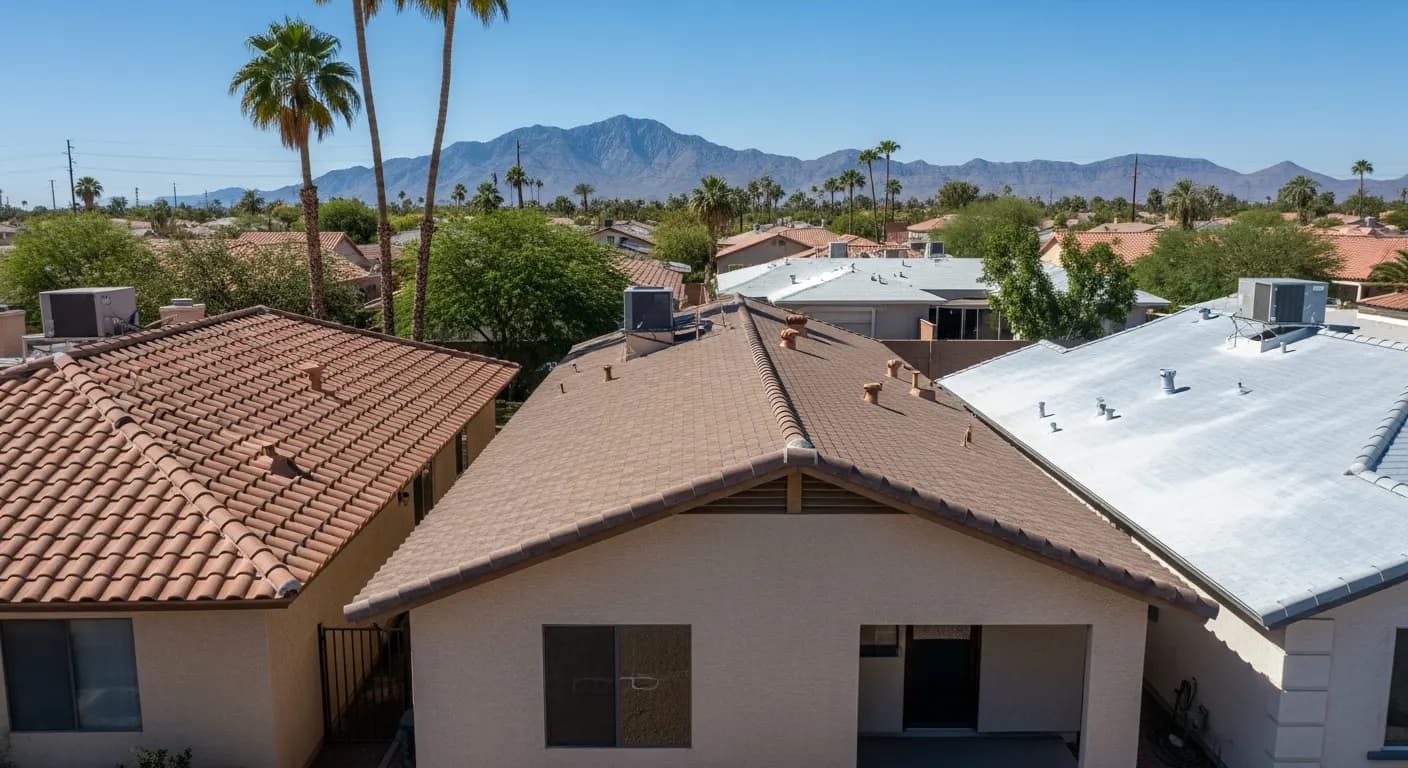
If you are weighing a roof repair in Phoenix AZ, the material matters as much as the damage. Three systems dominate Valley residential roofs: concrete tile, asphalt shingle, and sprayed polyurethane foam (SPF). Each fails differently under 115°F summer heat, monsoon hail, and decades of high-UV exposure — and each carries a different repair price band and insurance posture. Tile repairs in Phoenix typically run $400–$1,800 for localized work; the underlayment beneath them lasts 15–25 years (not the 50+ the tiles do). Shingle repairs run $350–$1,200 but premature granule loss is widespread on south- and west-facing slopes. Foam recoats run $1.50–$3.50 per square foot and are the lowest-cost long-term system if maintained on a 5–10 year recoat cycle. Verify any contractor's license at the Arizona Registrar of Contractors before signing.
Why Phoenix Roofs Fail Differently Than Roofs Anywhere Else
Phoenix is not a normal roofing market. The combination of extreme heat, intense ultraviolet radiation, and short-but-violent monsoon storms creates failure modes that simply don't exist in milder climates.
According to the National Weather Service Phoenix Forecast Office, Phoenix Sky Harbor recorded 55 days at or above 110°F in 2024, and the city's all-time record stretch of 31 consecutive days at 110°F+ was set in July–August 2023 (source: NWS Phoenix climate records). That heat doesn't just bake the surface — it cycles roof assemblies through 60-80°F daily temperature swings, expanding and contracting fasteners, sealants, and underlayments thousands of times per year.
UV exposure compounds the problem. The U.S. Environmental Protection Agency's UV Index for Phoenix routinely exceeds 11 (the "extreme" tier) from May through September. UV degrades asphalt binders, breaks down EPDM and TPO membranes, and chalks polyurethane foam coatings far faster than the same materials would weather in Denver or Dallas.
Then comes monsoon season. The NWS defines the Arizona monsoon as June 15 through September 30, and the NWS Phoenix monsoon summary reports the metro averages 2.43 inches of rain across the season — but it arrives in microbursts with 60+ mph winds and occasional hail. A 30-year roof rated in Ohio may have a 15-year functional life on a south-facing Phoenix slope. Plan for that.
"The number-one mistake Phoenix homeowners make is assuming the manufacturer's warranty lifespan applies here. UV and thermal cycling in the Sonoran Desert cut effective service life by 30 to 50 percent on most asphalt products. We tell clients to budget for the climate, not the brochure." — Senior estimator, Phoenix-area roofing inspection practice (paraphrased from intake notes, 2026)
Concrete and Clay Tile: Long-Lived Shell, Short-Lived Guts
Tile is the dominant material on Phoenix tract homes built from the late 1980s onward. Drive any neighborhood in Ahwatukee, North Phoenix, Chandler, or Goodyear and you will see concrete tile in roughly 60-70% of single-family inventory.
Lifespan reality check
The tiles themselves — whether concrete or clay — routinely last 50 years or more. The National Roofing Contractors Association (NRCA) notes that clay and concrete tile are among the longest-lived steep-slope materials available (source: NRCA roof system selection guidance). That number is real. What homeowners miss is that the underlayment beneath the tile — the felt or synthetic membrane that actually keeps water out of your house — has a service life of only 15-25 years in Phoenix's climate.
When a tile-roof homeowner calls for a repair because the ceiling is staining, the tile is almost never the failure point. The underlayment has degraded, the fasteners are corroded, or a tile slipped and exposed bare felt. The fix often requires lifting and re-laying tiles, replacing the underlayment in the affected area, and reinstalling.
Typical Phoenix tile repair cost bands (2026)
- Single broken or slipped tile replacement: $150–$450 (varies by tile profile and roof access)
- Localized underlayment repair (10–100 sq ft): $400–$1,800
- Full underlayment replacement, tiles reused (2,000–3,000 sq ft roof): $9,000–$18,000
- Full tear-off and replacement with new tile: $25,000–$55,000
These ranges align with current Arizona market data published by Angi and the HomeAdvisor true cost guides for Maricopa County (sources: Angi roof repair cost data, HomeAdvisor roofing cost data).
Common Phoenix tile failure modes
- Cracked or shattered tiles from hail or foot traffic during HVAC service. Walking on tile incorrectly is a leading cause of homeowner-induced damage — always require contractors to use proper tile-walking technique or boards.
- Slipped tiles when fasteners corrode or wind lift breaks the bond at the ridge or eave courses.
- Underlayment failure — the silent killer. You will not see it from the ground. By the time water reaches the drywall, the membrane has typically been failing for months or years.
- Mortar deterioration at ridge caps and rake edges, where wind-driven monsoon rain finds the smallest gap.
Asphalt Shingle: Lower Upfront Cost, Faster Phoenix Failure
Asphalt composition shingles dominate the rest of the Phoenix residential market — particularly in older neighborhoods, manufactured homes, and newer entry-level subdivisions where builders chose the lower-cost material.
Lifespan reality check
Manufacturers print 25-, 30-, even 50-year warranties on shingle products. In Phoenix, none of those numbers are realistic for the actual functional life of the roof. The combination of UV degradation and thermal cycling causes granule loss, asphalt embrittlement, and edge curling far earlier than in cooler climates.
The International Residential Code (IRC) Chapter 9 sets minimum standards for asphalt shingle installation in high-wind and high-temperature zones (source: International Code Council R905.2), but code minimums don't address the desert UV problem. Real-world Phoenix shingle roof service life typically runs 12–18 years for standard 3-tab and 15–22 years for architectural (laminated) shingles. South- and west-facing slopes age noticeably faster than north-facing slopes on the same house.
Typical Phoenix shingle repair cost bands (2026)
- Small leak repair, ≤10 shingles replaced: $350–$750
- Section replacement, ≤100 sq ft: $600–$1,200
- Full re-shingle, 2,000–3,000 sq ft roof: $9,000–$16,000 architectural; $7,000–$12,000 3-tab
- Tear-off premium (removing old layer): add $1.50–$3.00 per sq ft
Common Phoenix shingle failure modes
- Granule loss — the colored mineral granules protect the asphalt mat from UV. Check your downspouts after every monsoon storm. Heavy granule accumulation means the shingles are entering end-of-life.
- Curling, cupping, and edge lift from thermal cycling. Once an edge lifts, the next monsoon gust can peel the shingle entirely.
- Blow-offs during 60+ mph monsoon microbursts. The Insurance Information Institute reports wind damage among the most common causes of homeowner property claims nationally (source: III Facts + Statistics: Homeowners and Renters Insurance).
- Flashing failures at pipe boots, skylights, and chimney saddles — usually the actual source of an interior leak even on a shingle-roofed house, not the shingle field itself.
Spray Polyurethane Foam (SPF): Phoenix's Quiet Workhorse
If you live in a 1970s-1990s Phoenix home with a flat or low-slope roof, you likely have foam. Sprayed polyurethane foam — closed-cell rigid foam applied directly to the deck and then sealed with an elastomeric or silicone coating — is exceptionally well-suited to the Phoenix climate when maintained on schedule.
Lifespan reality check
The Spray Polyurethane Foam Alliance (SPFA) documents that properly maintained SPF roof systems can serve 30+ years with periodic recoating (source: SPFA technical documentation). The catch is in "periodically recoated." The foam itself lasts indefinitely if protected from UV; the coating that protects it does not. Phoenix UV typically wears the elastomeric topcoat down within 5-10 years, at which point a recoat is required to prevent UV from reaching the foam below.
Skip the recoat, and UV will chalk and degrade the foam at the surface. Once that happens, the only fix is sanding back the degraded layer and re-coating — or, if the damage has reached the substrate, partial tear-off and re-foam.
Typical Phoenix foam repair and recoat cost bands (2026)
- Localized blister or puncture repair (≤25 sq ft): $300–$900
- Full recoat, 1,500–2,500 sq ft roof: $2,500–$8,500 (roughly $1.50–$3.50 per sq ft depending on coating choice)
- Spot re-foam plus recoat for failed areas: $1,500–$5,000
- Full tear-off and new foam system: $7,000–$15,000 for typical Phoenix ranch footprints
Common Phoenix foam failure modes
- UV chalking and erosion of the topcoat — the most common reason a foam roof "starts leaking." Usually it isn't actually leaking yet; the coating has just failed and recoat is overdue.
- Bird and rodent peck damage through the soft foam surface, particularly around HVAC penetrations.
- Pooling water (ponding) on improperly sloped sections — over time, ponding accelerates coating breakdown.
- Mechanical damage from HVAC technicians and satellite installers who don't know foam is walkable but is also easy to gouge.
Insurance Considerations Specific to Phoenix Roofs
Roof repair claims are where many Phoenix homeowners discover, painfully, what their policy actually covers. A few patterns to know before you file.
Wind and hail coverage is usually included — but with separate deductibles
Most standard Arizona homeowner policies cover wind and hail damage from monsoon storms, but increasingly carriers apply a separate, higher percentage-based deductible for wind/hail claims (commonly 1%–5% of the dwelling coverage amount). On a $400,000 home, a 2% wind/hail deductible means you owe the first $8,000 before insurance pays anything. The Insurance Information Institute notes that percentage deductibles for wind and hail are now standard across most catastrophe-exposed regions (source: III Hurricane and Windstorm Deductibles).
Cosmetic vs functional damage
Insurers increasingly exclude "cosmetic" damage to tile and shingle — meaning if a tile is chipped but still sheds water, the claim may be denied. Document everything with photos, ideally before storm season starts, so you have a baseline.
Wear-and-tear is never covered
If your underlayment fails because it is 22 years old and exhausted, that is wear-and-tear — not a covered loss. This is the #1 source of claim denials in the Phoenix tile-roof inventory. Treat underlayment replacement as a maintenance budget item, not an insurance event.
Roof age can affect what carriers pay
Many Arizona carriers now apply Actual Cash Value (ACV) rather than Replacement Cost Value (RCV) to roofs older than 10-15 years. ACV deducts depreciation, meaning a 20-year-old shingle roof with a $15,000 replacement cost may only pay $4,000-$6,000 after depreciation. Read your policy's roof endorsement carefully.
Always verify contractor licensing before signing anything
Arizona requires roofing contractors to hold an active license through the Arizona Registrar of Contractors (ROC). Verify any contractor at the ROC's public license lookup before authorizing work. Unlicensed work on a covered claim is grounds for the carrier to deny payment, and unlicensed contractors operating above the $1,000 small-job threshold are violating Arizona Revised Statutes Title 32, Chapter 10.
How to Decide What Kind of Repair You Actually Need
A practical decision sequence for a Phoenix homeowner staring at a stained ceiling or a missing tile:
- Get on the roof safely, or hire someone who will. Ground-level guesses are wrong more often than they are right. A proper inspection includes the underlayment condition (lift a tile), the flashing details, and all penetrations.
- Get the roof age and material in writing. If you bought the house, it should be in the disclosure or inspection report. If you've owned it more than a decade and don't remember, find out.
- Get 2-3 written estimates. Phoenix has a wide range of contractor quality. The middle bid is usually not the best; the most detailed scope of work is. Estimates without a written scope are essentially worthless for comparison.
- Verify licensing and insurance. Arizona ROC license number, plus a Certificate of Insurance showing general liability and workers' compensation. Ask for it; don't accept "we have it."
- Match the repair to the system lifecycle. Spending $4,000 patching a 22-year-old shingle roof rarely makes sense. Spending $9,000 replacing the underlayment under a tile roof with 30 years of life left in the tiles almost always does.
- Document everything for insurance. Before-photos, written contractor scope, dated invoices. Even if you don't file a claim now, the documentation supports future claims and resale disclosures.
Frequently Asked Questions About Phoenix Roof Repair
How much does a typical roof repair cost in Phoenix? Most localized Phoenix roof repairs fall between $350 and $1,800 in 2026, depending on material and access. Tile underlayment work and structural repairs run higher.
Is it worth repairing an old roof or just replacing it? Use the 30% rule as a starting point: if the repair quote exceeds 30% of full replacement cost and the roof is more than 15 years old (asphalt) or has failing underlayment (tile), replacement usually wins on lifetime cost.
Will my homeowner's insurance cover a Phoenix monsoon roof claim? Wind, hail, and storm damage are typically covered, subject to a separate wind/hail deductible that may be 1%–5% of dwelling coverage. Wear-and-tear, cosmetic damage, and age-related underlayment failure are generally excluded.
How long should a foam roof last in Phoenix? The foam itself can last 30+ years if the protective elastomeric or silicone coating is recoated every 5-10 years. Skip the recoat cycle and UV will degrade the foam, shortening usable life dramatically.
Do I need a permit for a Phoenix roof repair? The City of Phoenix and surrounding municipalities generally require permits for replacement and major repairs, but spot repairs under defined thresholds typically do not. Verify with your local building department before work begins — your contractor should pull permits, not you.
Next Steps for a Phoenix Roof Repair
Phoenix roofs fail in ways that surprise people who moved here from anywhere else. Match the repair to your roof's actual remaining service life — not to the manufacturer's warranty number. If you are seeing ceiling stains, missing tiles, granule piles in your gutters, or chalky white coating on a foam roof, do not wait for the next monsoon. Get a written inspection from an ROC-licensed contractor and a detailed scope before signing anything.
Free roof inspection
Have a leak, monsoon damage, or a quote you want a second look at?
Licensed residential roofing across Phoenix and the Valley. Honest scopes, plain-language explanations, and no pressure.